Friday, October 29, 2010

Fake MySpace/Facebook Issues - My Stance


Social networking is a way for one person to meet up with other people on the net. Social networking sites are online communities of internet users who want to communicate with other users about areas of mutual interest, whether from a personal, business or academic perspective.  The specific functionality of the various sites may differ, but in general, the sites allow you to provide information about yourself and communicate with others through email, chat rooms and other forum.
The popularity of social networking sites, such as MySpace, Facebook, Twitter, and others has exploded in recent years, with usage in the United States increasing 93% since 2006, according to Netpop Research.   The sites are popular not only with teenagers, but with adults as well: the number of adult internet users having a social networking profile has more than quadrupled in the past four years, according to the Pew Internet and American Life Project.

Social network sites are growing in popularity as attack vectors because of the volume of users and the amount of personal information that is posted. The nature of social networking sites encourages you to post personal information.  Because of the perceived anonymity and false sense of security of the internet, users may provide more information about themselves and their life online than they would to a stranger in person. The information you post online could be used by those with malicious intent to conduct social engineering scams and attempt to steal your identity.
According to the Cumberland County School (CCS) District Technology Policy students have Legal obligations. Students in Middle and High school have internet accounts and they and parents have to sign an agreement stating that they agree to adhere to all federal, state, and local laws regarding the use of technology. These include but not limited to:
701JAR 5L120 Prevention of Objectionable Material Transmitted to Schools via computer
KRS 434.854 Misuse of Computer Information

The Student Technology Use Policy is intended to work with other District School policies. Violations of school discipline codes and/or other policies where technology is used can be considered a Violation of the Acceptable Use Policy. Students are not permitted to do the following: Harassing, insulting or attacking others. 
 Violations of these policies may result in restricted technology privileges suspension of all technology privileges or other consequences deemed appropriate. The consequences will follow the guidelines in the School/District Code of Conduct/Discipline Policies and deemed appropriate by the school principal and/or district Superintendent.

As a prospective administrator maybe I would have reacted to the situation as the administrators reacted in the cases I have read. If a student should create a slanderous MySpace or Facebook profile about me, my reaction would be dependent on the content of the slander. I think I would want to probably file a law suit, just to teach the students involved a lesson, as one principal did.

From my perspectives school districts should include policies in their School’s Code of Conduct where parents and students sign at the start of the year. These should include the consequences in creating slanderous profile of both staff and students on the various social networking sites, such as Facebook and MySpace. I would ensure that students are aware that when they indulge in these activities it could have lasting implications.

For example middle and high school students should be aware that college admissions officers and school administrators, do visit these sites and in some cases, admissions are denied to applicants, or disciplinary actions have been taken because of information or photos posted on line. Employers also review these sites for information about potential job applicants.  

Some consequences I would include as an administrator are:
  • Suspensions of up to ten days
  • Ensuring that student make a public apology and recant slanderous/malicious profile created

 What Administrators May Legally Do
These are some relevant Case Laws that can support administrators if they decide to take legal actions against a student who creates malicious or slanderous profiles about them on MySpace or Facebook:
1.      Bethel School District v. Frazer, which said public schools, could “prohibit the use of vulgar and offensive terms in public disclosure.”
2.      Hazelwood School District v. Kuhlmeier, which said, “educators do not offend the First Amendment by exercising editorial control over the style and content of speech so long as their actions are reasonably related to legitimate, pedagogical concerns.”     
3.      Morse v. Fredrick, which ruled that school officials, could censor a student’s speech that was “reasonably viewed as promoting illegal drug use.”
4.      1976 district court case that upheld school jurisdiction over off- campus student speech. Fenton v. Stear, where the court ruled “when a high school student refers to a high school teacher in a public place on a Sunday by a lewd and obscene name in such a loud voice that the teacher and others hear the insult, it may be deemed a matter for discipline in the discretion of the school authorities.

Friday, October 22, 2010

Cyberbulling in Schools

"Cyber bulling is when someone is being bullied or treated unfairly by way of the Internet. The cyber bulling could be through blogging or e-mail access,” http://answers.ask.com/

                                           http://www.youtube.com/watch?v=O3nRSKDlvJk

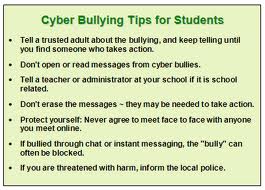
Cyber bulling is where the bully uses cell phones, instant messages, e-mail, chat rooms, or social networking sites such as Face book and twitter to harass, threaten or intimidate someone. Cyber bulling can include such as making treat, sending provocative insults or racial or ethnic slurs, gay bashing attempting to infect the victim’s computer with a virus, and flooding an e-mail inbox with messages.
Because the use of mobile and online communications has grown so rapidly and the crime is relatively new, many jurisdictions are deliberating over cyber bulling laws. However, the crime is covered by existing laws against personal treats and harassment. In some cases, it may be advisable to inform the local police department or consult an attorney.
 Statistics adopted from the youth research compiled at cyber bulling.us indicate that 33 percent of youths have been victimized by cyber bulling. The primary location where victimizing occurs is in chat rooms. This amounts to fifty-six percent (56%).  Forty nine percent (49%) are victimized via instant messages and 28% via e-mail.  17% admitted to bulling another individual online.  These are some more statistics by the Cyber bulling Research Center on cyber bulling:
   

Included in the Cumberland County Schools (CCS) Technology Plan is an Internet Use Policy (IUP) for student. Teachers are required to display the in their classrooms. Students and parents are required  to sign a new IUP each year.  However, the plan does to make reference to cyberbulling.  According  to the the North Carolina Criminal Law,  “ North Carolina has a  new cyberbulling law making it a misdemeanor to undertake various computer activities in order to intimidate, torment, or harass minors.  http://sogweb.sog.unc.edu/blogs/ncclaw/?tag=cyberbullying
 As a teacher, and prospective administrator I think that each school should include cyberbulling in their school technology plan.  This is a crime that is fast increasing, and many teens are losing lives as a result of cyberbulling.  Schools and educators through their technology specialist can educate students on proactive measures to use the Internet safely.  Students should be educated on what to do if they suspect that they are being attached by a person via the Internet. Though the school newsletters can be sent home to inform parent on how to monitor their children use of Internet at home and also use of cell phone.
Guidance counselors can share stories with students of the effects of cyber-bulling and also incidents where students have been cyberbullied.  The school could also set up a hot line where students can call if they are being victimized by cyber bullies.

More active measures include blacklisting or white listing e-mail accounts, changing e-mail addresses. Changing ISP’s, changing all phone accounts, and attempting to trace the source.
There students are victims of cyber-bulling, both teen died as a result of being cyber-bullied.
 
Alexis Pilkington

Phoebe Prince


Friday, October 8, 2010

Reflection on My Youtube Tutorial Project

WOW! WHAT CAN I SAY? THIS HAS BEEN A JOURNEY!


This is how I feel now!!!!!!

                                              http://www.screencast.com/t/UQ1Dtvfqls     
              
During the recording of my tutorial video on YouTube I felt frustrated, and sometimes I felt motivated. The cartoons pictures at the top depict just how I felt.  The first step was to download the jing program to my computer, (this was the easiest part).  But, then I could not figure out how to use it (Arlene's Tutorial on Jing would have been beneficial at this time). After many phone calls, e-mails, viewing tutorials online and of course playing around with it, I began to enjoy the recording part of jing.                                       
This was how I felt then?????
I must have done over thirty recordings and still could not decide on which one to use. Each one had a different mistake or I did not get a chance to say all of what I wanted to say as jing only offered me five minutes.  I can now imagine what directors of movies, music videos and commercials go through, ( when they have to do so many TAKES).
I have learned so much, from my tutorial and also from my other classmates tutorials. I feel very comfortable to use slideshare, skype, wordle, animoto, jing, and google maps just to name a few.  I have also learned how these web 2.0 tools can be utilized in my classroom to enhance my lessons. I know that my first graders would especially enjoy jing as while I worked on my tutorial, my daughter (who is in first grade) also did her recordings and she loved it.
What I found amazing throughout this journey is the fact that any video I needed to find was probably on YouTube. There are so many videos there. You can pick, choose, and refuse. Before doing this, I had misconceptions of YouTube. I previously saw it as a website that I would not be apart of. But, now I have an account and I can upload my own videos, as there is the option of making them private, so only my family and friends would be able to see them.
After all of this, and from all that I have learnt, I am able to use web 2.0 tools such as these.

Thursday, September 30, 2010

Monday, September 20, 2010

VIF-6: THIS IS FOR YOU ALL !!!

This song is for ALL of us: And to Dr. Watwood. Thank you for pushing us to beyond the limit!!!!!

PLEASE LISTEN TO THE LYRICS!


Kudos to all of my classmates. You teachers are phenomenal. It is an enormous task to be away from our home country. We have adjusted to living and working here in the U.S.A.  Most of us are parents, wives and hushands. And we are juggling all of that PLUS reading for our Masters Degree. WOW!

Stop for a while and think. Some people would be comfortable where they are in life. But we ALL see it fit to be PUSHING OURSELVES BEYOND THE LIMIT.

Have fun working on your tutorials. ONE LOVE!!!

Saturday, September 18, 2010

Blogs I have Read - My Comments


As I venture into the world of "educational blogospere" there were quite a few blogs that captured my attention. One in particular was blogger Stephen Downes http://halfanhour.blogspot.com  In his response to the question: What is your vision of the school of the future? He answered with this diagram:-

The picture is labeled school 2.0 and he went on to point out that the end point of new education technologies is that society as a whole becomes the "immersive environment."  This particularly endorses the point where he said that what  new technologies will enable is the possibility of taking education outside the school to have children and young adults learn by participating in the functioning of social function - everything from creating community maps to documenting history and more.

I was also awed by the post of Around the Corner at http://mwacker.blogspot.com. In his blog post "Ed Tech Experts Choose Top 3 Tool via thejounal.com . I specifically liked the way he articulated his points in his post. I was also amazed that he ranked blogs as the number one tool for learning in web 2.0 agreeing with Steve Hargadon number one choice.  As a new blogger I can concur with him that "blogging can be a literal, adaptive, and also tranformative use of technology." He cited that blogs allow for scaffolded and secure use, while naturally lending itself to differentiation of instruction in the classroom.  

My last blog is from the post of blogger http://edtechpower.blogspot.com  where she interviewed Steven Hargadon on his reflection of the early days of classroom 2.0. You may watch excerpts at: http://www.youtube.com/watch?v=nEG391LbN8I

I find it easier to identify pros than cons in reading educational blogs:
Pros:
1. You can learn from other colleagues
2. It is a means of reflecting on classroom practices
3. Social networking
4. Creating and sharing ideas, strategies, and techniques that have proven successful.
5. Collaborative tool

Cons:
1. I am still thinking of one. I will be sure to add it in my next blog post it I think of it.

There are many benefits of using a aggregator like google reader as it servers as a RSS feeder (both online and offline) where you can be easily linked to your blog account and other web 2.0 tools such as twitter and delicious. You can read your bogs and posts of bloggers that you follow. It just servers as another handy management tool. 

My blogs can impact my teaching in a positive way. For I see it as a journal. One that I can write my reflections in (as I am doing right now).  I am hoping to develop a habit, of it hoping it will be more relaxing as then I will not be graded on my posts.


Friday, September 17, 2010

Reflection on Vicki Davis Blog Post

Potential Use of Web 2.0 in Education – My Views


As I immerse myself into this course, reading, and exploring the potential and benefits of web 2.0 in the classroom and in the future of education.  I am captivated by all of what I have seen, read, and discovered, and still unraveling as to the potential of catering to our students learning via web 2.0.  And, I am amazed at what there is and what I expect to come!

Vicki’s post was very interesting.  I thought it was a great strategy how she integrated cell phone technology in her classroom.  From her post it was evident that the students were involved, engaged, motivated and learning.  Vicki  has used web 2.0  and cell phones to equip her students with skills, not just for her classroom, but skills that will be beneficial to them in the future – college and eventually their career.  Thus, I want to share this video with you all, not just Vicki's vision but, also a global vision for our learners: http://www.youtube.com/watch?v=EjJg9NfTXos

And I ask myself the question: What is the reason for education? What are we preparing students for daily? Aren’t we supposed to prepare them to function in the world? As Vicki pointed out in her post and I quote: “These tools are becoming ubiquitous, unblockable, and virtually unstoppable and there is really no excuse for saying they are unusable in the classroom” Vicki Davis (2008).
 The students were learning to Jott, use google calendar and their igoogle account from their cellphones. I thought about it, and it was simple, these students were gaining organizational skills and how to manage their daily tasks through web 2.0 on their cell phones.   

I was excited and motivated at how bold she was to get her principal to see her vision and enthusiasm to allow her to  let her students to use cell phone , knowing that schools today BAN the use of cell phones in school.   Her principal should be commended. I would want to shake his hand for being a person of vision who supported her and endorsed her suggestions and aspirations.
The students we teach today are “digital natives” as Medley and Mabrito stated in their article “Why Professor Johnny Can’t Read”. They are N-Gen learners and we as teachers need to cater to their learning styles, just as Vicki saw it fitting to do in her classroom. They were able to create and consume, (prosumers).
I am also optimistic that other educators and administrators will be motivated by what she has done. They can now explore ways where they can positively and creatively use web 2.0 technologies in classroom.


  We as teachers can all reflect on a particular quote from Will Richardson’s blog “School as a video game”   What if teachers give up the vestiges of their educational past, threw away the worksheets, burn the canon and reconfigured the foundation upon which a century of learning has been built? What if we blurred the lines between academic subjects and reimagined the typical American classroom so that at least in theory, it came to resemble a typical American living room or a child’s bedroom or even a child’s pocket circa 2010, - if in other words, the slipstream of broadband and always – 0n technology that fuel our world became the source and organizing principle of our children’s learning? What if, instead of seeing school the way we’ve known it, we saw it for what our children might dreamed it to be: a big, delicious video game? 
I support this piont as we need to move away from how we were taught and venture into a new approach to teaching these kids who were born and are growing up with pervasive digital technology.
I am learning and has joined the "education blogosphere." My views have certainly changed. I am now in the category of prosumers and am very proud of it.  My blogs have helped me to reflect on what I am doing and what changes I can make in the future. From reading other educational blogs, I have certainly learned a lot. I have been exposed to what stategies have worked for other educators. I am able to share what has proved beneficial for me.  My fellow colleagues can share their comments with me, thus giving me feedback. Which is vital.
My school and my first grade team will be one of the pilot schools for a Gateway Program in the School District.  The future is bright for my first graders as we will be venturing into the use of web 2.0 in the classroom. The first graders at my school will be using skype to communicated with students from other countries.
This video concludes the point of my reflection:http://www.youtube.com/watch?v=vPO_HGafBsE